

22 Mar How Nature Can Make You Kinder, Happier, and More Creative
This article is a few years old now.
But it’s always good to be reminded of the benefits of nature.
There’s really good research to support the notion that spending time in nature makes you happier and kinder and so much more.
So if happiness and kindness and creativity are some of your goals, read on and then … I’ll see you out there!
via Greater Good by Jill Suttie
I’ve been an avid hiker my whole life. From the time I first strapped on a backpack and headed into the Sierra Nevada Mountains, I was hooked on the experience, loving the way being in nature cleared my mind and helped me to feel more grounded and peaceful.
But, even though I’ve always believed that hiking in nature had many psychological benefits, I’ve never had much science to back me up…until now, that is. Scientists are beginning to find evidence that being in nature has a profound impact on our brains and our behavior, helping us to reduce anxiety, brooding, and stress, and increase our attention capacity, creativity, and our ability to connect with other people.
“People have been discussing their profound experiences in nature for the last several 100 years—from Thoreau to John Muir to many other writers,” says researcher David Strayer, of the University of Utah. “Now we are seeing changes in the brain and changes in the body that suggest we are physically and mentally more healthy when we are interacting with nature.”
While he and other scientists may believe nature benefits our well-being, we live in a society where people spend more and more time indoors and online—especially children. Findings on how nature improves our brains brings added legitimacy to the call for preserving natural spaces—both urban and wild—and for spending more time in nature in order to lead healthier, happier, and more creative lives.
Here are some of the ways that science is showing how being in nature affects our brains and bodies.
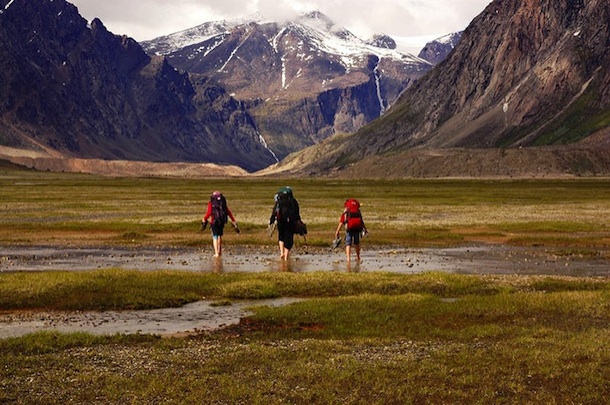 Peter Morgan, Auyuittuq National Park
1. Being in nature decreases stress
It’s clear that hiking—and any physical activity—can reduce stress and anxiety. But, there’s something about being in nature that may augment those impacts.
In one recent experiment conducted in Japan, participants were assigned to walk either in a forest or in an urban center (taking walks of equal length and difficulty) while having their heart rate variability, heart rate, and blood pressure measured. The participants also filled out questionnaires about their moods, stress levels, and other psychological measures.
Results showed that those who walked in forests had significantly lower heart rates and higher heart rate variability (indicating more relaxation and less stress), and reported better moods and less anxiety, than those who walked in urban settings. The researchers concluded that there’s something about being in nature that had a beneficial effect on stress reduction, above and beyond what exercise alone might have produced.
In another study, researchers in Finland found that urban dwellers who strolled for as little as 20 minutes through an urban park or woodland reported significantly more stress relief than those who strolled in a city center.
The reasons for this effect are unclear; but scientists believe that we evolved to be more relaxed in natural spaces. In a now-classic laboratory experiment by Roger Ulrich of Texas A&M University and colleagues, participants who first viewed a stress-inducing movie, and were then exposed to color/sound videotapes depicting natural scenes, showed much quicker, more complete recovery from stress than those who’d been exposed to videos of urban settings.
These studies and others provide evidence that being in natural spaces— or even just looking out of a window onto a natural scene—somehow soothes us and relieves stress…
… keep reading the full & original article HERE